

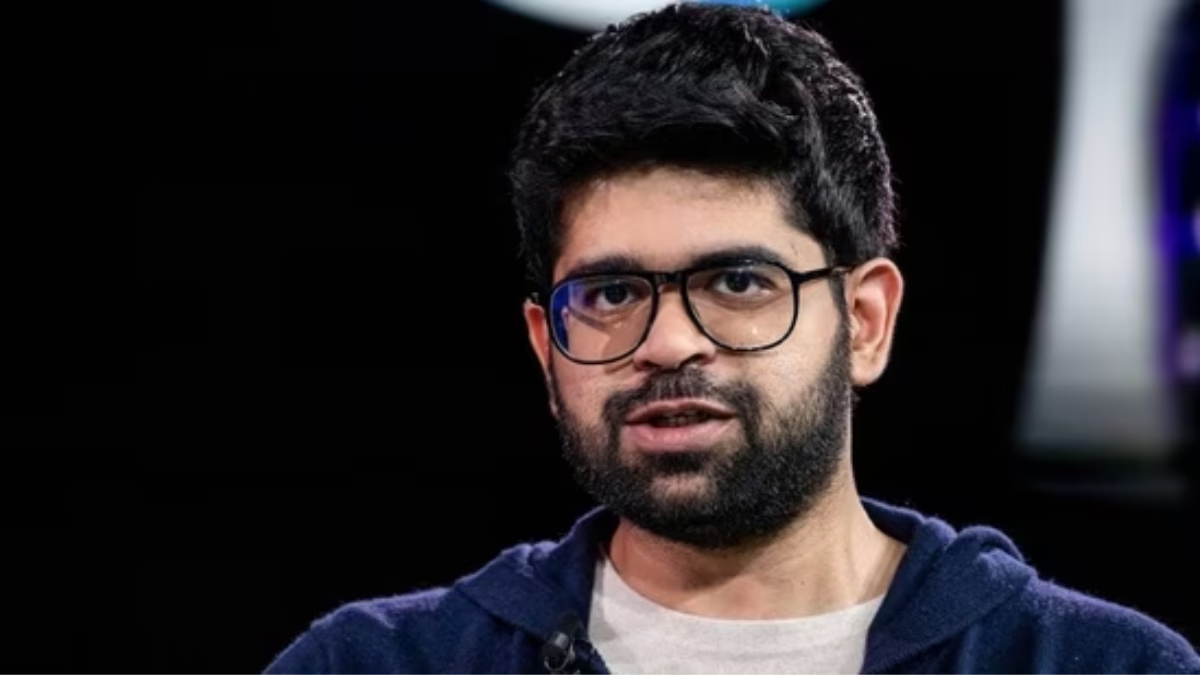
In a world where tech giants are racing to build massive, power hungry hubs for artificial intelligence, Aravind Srinivas has issued a startling contrarian warning. The Perplexity CEO, whose company is at the forefront of the AI search revolution, recently suggested that the multi-billion dollar data centers currently under construction across the globe might soon become irrelevant.
As Microsoft, Google, and Meta pour trillions into centralized infrastructure, Srinivas argues that the true future of AI is not in the cloud, but in your pocket. This shift from centralized servers to local devices represents what he calls a ten trillion-dollar question for the entire technology sector.
The Biggest Threat to Centralized Infrastructure
According to Srinivas, the primary existential threat to the current data center model is the rapid advancement of on device intelligence. During a recent podcast interview, he explained that if intelligence can be packed locally onto a chip running on a smartphone or laptop, the need for centralized inference vanishes.
Currently, every time you ask an AI a question, that data travels to a distant server, is processed by a massive GPU, and is sent back to you. This process is not only expensive and energy intensive but also creates latency. Srinivas believes that as silicon becomes more efficient, the same level of sophisticated reasoning will happen directly on our personal hardware.
A Digital Brain That Lives with You
The most compelling part of this vision is the idea of personalized, private AI. When artificial intelligence runs locally, it can observe your workflows and habits without ever sending that sensitive data to a remote server. This creates a feedback loop where the AI learns from your repeated tasks and begins to automate them on your behalf.
Srinivas describes this as a digital brain that belongs entirely to the user. Unlike cloud based models that are generic and overseen by corporations, a local model becomes an extension of your own thinking. You own the intelligence, and you own the data. This level of personalization is difficult to achieve in a centralized model where privacy concerns and data transfer costs act as constant bottlenecks.
The Economics of a Decentralized Future
The financial implications of this shift are staggering. The tech industry is currently operating on the assumption that we need more and bigger data centers to handle the growing demand for AI. However, if a significant portion of the workload moves to edge devices, those gleaming new facilities could become stranded assets.
Srinivas questions whether it makes sense to spend five hundred billion or five trillion dollars on centralized hubs if the intelligence workloads can be handled independently by billions of consumer devices. This decentralized model would drastically reduce the massive electricity and water consumption associated with cooling large server farms, making AI more sustainable in the long term.
Challenges on the Path to On Device AI
While the vision is bold, Srinivas acknowledges that the industry has not reached this milestone quite yet. No company has successfully shipped a model that is small enough to fit on a local chip while remaining intelligent enough to complete complex tasks reliably.
The transition will require a massive leap in chip design and model optimization. Companies like Apple, with its M series silicon, and Qualcomm are currently leading the charge. Once a high quality model can run efficiently on a MacBook or an iPad without draining the battery or overheating, the disruption to the data center industry will begin in earnest.
The End of the Cloud Monopoly?
For decades, the cloud has been the center of the digital universe. It allowed companies to scale quickly and gave them immense power over user data. If Aravind Srinivas is correct, we are moving toward a hybrid future where the cloud is reserved for massive training tasks, while the day to day intelligence lives on our own devices.
This shift would democratize AI, giving individuals the same powerful tools as large institutions without the need for an expensive subscription to a centralized provider. It represents a move away from intelligence as a service and toward intelligence as a personal asset.