

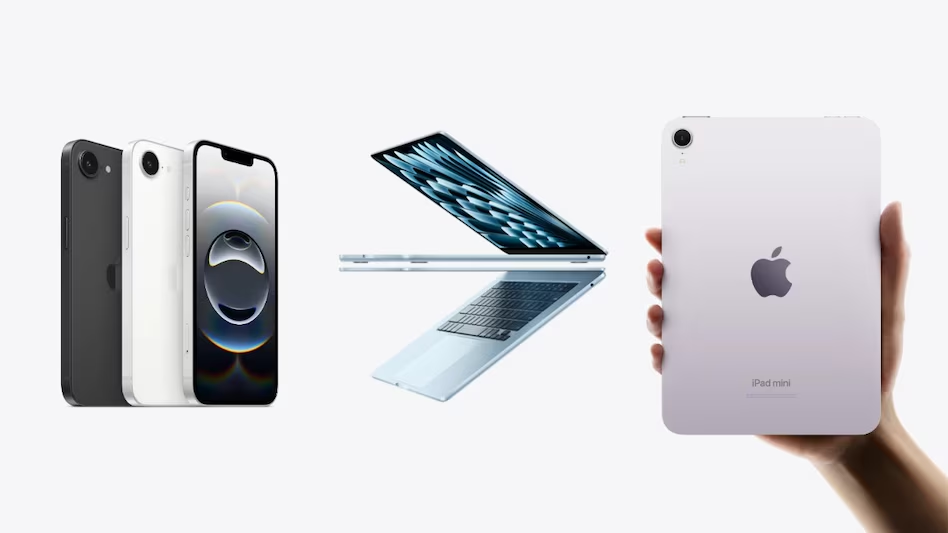
The global technology market received a massive shock this week as Apple officially announced significant price increases across its entire lineup of Mac computers and iPad tablets. In an unexpected overnight update, the tech giant updated its online store with revised pricing structures that see some devices jumping in cost by over twenty percent. This sudden move marks one of the broadest and most uniform overnight price hikes in the history of the company, leaving consumers and industry analysts scrambling to understand the underlying causes.
While Apple has historically reserved price adjustments for major product launch events or regional currency fluctuations, this global increase targets active, existing hardware generations. Chief Executive Officer Tim Cook had previously hinted at the possibility of unavoidable adjustments, describing the current pressure on hardware manufacturing as completely unsustainable. For millions of consumers planning to upgrade their digital setups, the reality of more expensive Apple ecosystem entry points has officially arrived.
The Reality Of Tech Inflation In Twenty Twenty Six
The updated retail prices became visible globally after Apple temporarily took down its digital storefront to apply the sweeping changes. For years, the company managed to absorb fluctuating supply chain expenses, shielding its massive customer base from volatile market conditions. However, the corporate leadership clarified that the scale of current manufacturing costs made it impossible to maintain previous retail price points without severely harming hardware profit margins.
Interestingly, the price adjustments have been concentrated specifically on computing and tablet divisions. Major blockbusters like the iPhone, alongside popular accessories such as the Apple Watch and AirPods, have managed to escape the price hikes for the time being. Investors reacted quickly to the news, causing Apple shares to drop nearly five percent immediately following the official press statement, reflecting widespread concern over how these higher costs might impact consumer purchasing volumes over the coming quarters.
The AI Boom Triggered A Massive Memory Component Crisis
The primary catalyst behind this unprecedented move is an intense global shortage of vital memory and storage components. According to official statements from Apple, the explosive expansion of artificial intelligence data centers has completely reshaped the global semiconductor landscape. Artificial intelligence infrastructure demands massive quantities of high bandwidth memory, and massive cloud computing providers are aggressively buying up available factory capacities worldwide.
This hyper competitive environment has created a phenomenon that industry experts call chipflation. With finite manufacturing capabilities globally, top silicon suppliers have pivoted their operations to prioritize lucrative data center clients over traditional consumer electronics brands. Industry tracking reports indicate that random access memory costs shot up by nearly one hundred percent early in the year, with further steep increases continuing into the summer months. Apple openly acknowledged that the severity of this memory crunch has proven far more disruptive to its global supply chain than previous logistical challenges or international trade disputes.
A Detailed Breakdown Of The New Mac And iPad Price Structure
The price increases are felt immediately across both entry level devices and professional configurations, with most models seeing a bump of at least one hundred dollars. The highly popular MacBook Neo, which previously served as an accessible entry point at five hundred ninety nine dollars, has now risen to six hundred ninety nine dollars. Meanwhile, the standard MacBook Air powered by the M5 processor now features a starting price of one thousand two hundred ninety nine dollars, representing a two hundred dollar increase from its original retail introduction.
The professional tiers experienced even steeper adjustments, with the base fourteen inch MacBook Pro climbing to one thousand nine hundred ninety nine dollars. The tablet family saw similar adjustments across all performance categories. The standard base iPad rose from three hundred forty nine dollars to four hundred forty nine dollars, while the compact iPad mini jumped to five hundred ninety nine dollars. Users looking at the mid tier eleven inch iPad Air will now face a retail price of seven hundred forty nine dollars, while the premium thirteen inch iPad Pro has moved up to a starting point of one thousand four hundred ninety nine dollars.